Three dice, over 40 betting combinations, and a random multiplier engine that can turn a modest wager into a four-figure payout in under ten seconds. That's the arithmetic reality behind Lightning Sic Bo, a live casino variant that took the centuries-old Chinese dice game and bolted on an electrified bonus mechanic borrowed from the Lightning roulette family. The result is faster, riskier, and considerably more volatile than traditional Sic Bo - which is exactly why it has attracted a new wave of players who found the original format too slow or too flat in its payout structure.
What makes this variant worth studying rather than just playing on instinct is the interaction between fixed house-edge odds and randomly applied multipliers. A single bet, like a specific triple, might carry standard odds of 180 to 1, but if a lightning strike lands on that number, the payout can spike into the thousands. Before risking real money, most experienced players work through a full lightning sic bo review guide to understand how often strikes occur and which bets benefit most. For a detailed breakdown of session data and interface mechanics, this lightning sic bo review covers how the multiplier system behaves across extended play, which is useful context before committing to any particular staking pattern. Understanding that behavior separates disciplined players from those chasing variance blindly.
This guide breaks down the odds, the payout tables, the bonus mechanics, and the practical strategy adjustments that matter once electrified multipliers enter the equation.
How Lightning Sic Bo Works: Core Mechanics Explained
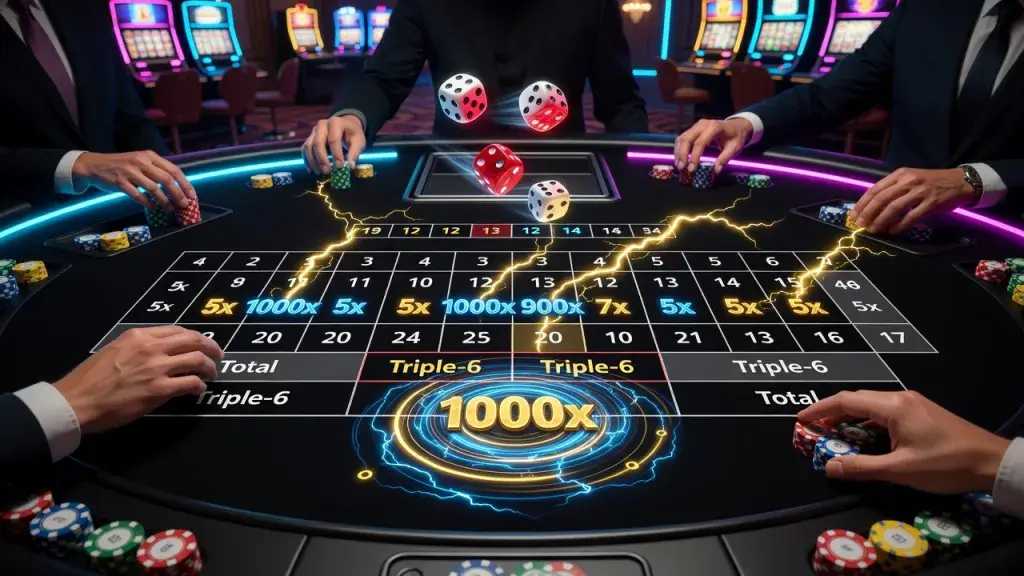
Lightning Sic Bo keeps the ancient dice-game skeleton intact - three dice, shaken and revealed simultaneously - but changes what happens between the shake and the payout. Before each round, the game's random number generator selects between one and five numbers (from 1 to 6) and assigns them a multiplier, typically ranging from 5x up to 1000x, though the exact range depends on the platform hosting the game. These numbers are the "lightning numbers" for that round only, and they reset every time.
The Dice, the Table, and the Digital Layer
Physically, nothing about the dice or the table layout has changed from classic Sic Bo. Players still bet on totals, combinations, specific triples, or individual number appearances. The digital layer sits on top, applying multipliers to specific number bets that hit within a struck round. This means the core game logic remains familiar to anyone who has played traditional Sic Bo, while the payout ceiling gets pushed dramatically higher.
Where the Electrification Actually Applies
Multipliers only apply to single-number bets - wagers that a specific die face (1 through 6) will appear at least once among the three dice. Totals, combinations, and triple bets are unaffected by the lightning mechanic and pay according to their standard fixed odds. This distinction matters enormously for strategy, because it concentrates the electrified upside into a narrow slice of the betting map.
Round Timing and Betting Windows
Each round follows a strict sequence: betting window opens, lightning numbers get drawn and displayed, betting closes, dice are shaken, and results are revealed. The entire cycle typically completes in under a minute, which is faster than most live traditional Sic Bo tables. Speed increases the number of decisions a player makes per session, which in turn increases the importance of having a lightning sic bo strategy defined in advance rather than improvised bet by bet.
Lightning Sic Bo Odds: What the Numbers Actually Mean
Odds in Sic Bo are fixed by the mathematics of three six-sided dice, and Lightning Sic Bo inherits that same probability structure unchanged. What differs is how the potential payout on certain bets gets amplified by the multiplier layer, not the underlying chance of any given outcome occurring.
Single Number Bets
Betting that a chosen number appears on at least one of the three dice carries roughly a 42% chance of winning if it shows once, with smaller probabilities for it appearing twice or three times. Base payouts scale with frequency: 1 to 1 for one appearance, 2 to 1 for two, and 3 to 1 for three. These are precisely the bets eligible for lightning multipliers, making them the strategic centerpiece of the entire game.
Combination and Total Bets
Two-number combination bets (say, a 4 and a 5 appearing together) pay a flat 6 to 1 and carry no multiplier eligibility. Total bets, which wager on the sum of all three dice, range from 6 to 1 up to 60 to 1 depending on how far the total sits from the statistical middle. Totals of 4 or 17, for instance, are rare enough to command the highest fixed payouts.
Triples and Doubles
Specific triples (three matching dice, like triple-6) are the rarest outcome in the game, occurring in roughly 1 out of 216 rolls, and pay out at odds as high as 180 to 1 on many tables. Any triple (any matching set regardless of number) pays lower, usually around 30 to 1, because it's a broader, more achievable outcome. Neither of these bet types is affected by lightning multipliers, which is a detail newer players frequently misunderstand.
Lightning Sic Bo Payout Structure Compared to Classic Sic Bo
The payout table is where Lightning Sic Bo genuinely diverges from its traditional counterpart, even though the base odds remain nearly identical. Classic Sic Bo pays flat amounts regardless of session history; Lightning Sic Bo introduces volatility on top of a familiar foundation.
Base Payouts vs. Multiplied Payouts
On an unstruck round, single-number bets pay exactly what they would in classic Sic Bo - nothing changes. But when a round is struck and a player's chosen number lands within the winning dice, the payout for that specific bet gets multiplied by whatever value the lightning round assigned, sometimes reaching 1000x the original stake. This creates two entirely separate payout realities within the same game, depending on whether a strike occurred.
- Unstruck single-number win: standard 1:1, 2:1, or 3:1 payout
- Struck single-number win: base payout multiplied by the assigned lightning value, up to 1000x
- Combination, total, and triple bets: always paid at fixed odds, never multiplied
Why the House Edge Doesn't Disappear
A common misconception is that lightning multipliers reduce the house edge. They don't. The overall return to player is balanced by a small commission or adjusted base payout on multiplier-eligible bets, meaning the operator recoups the cost of occasional massive multiplier hits through slightly reduced baseline returns across the board. This is standard practice across every Lightning-branded game in this genre, not unique to Sic Bo.
Realistic Payout Expectations Over a Session
Because lightning strikes are randomly distributed and only some strike rounds actually connect with a player's chosen numbers, most sessions will feature far more standard payouts than multiplied ones. Treating the multiplier as a rare bonus rather than an expected outcome keeps expectations grounded and prevents the kind of overbetting that erodes a bankroll quickly.
Lightning Sic Bo Bonus Features and How They Trigger
The bonus layer is what separates this variant from every other Sic Bo format on the market, and understanding its trigger conditions is essential to playing with any degree of control.
The Lightning Number Draw
Before betting opens, or in some versions immediately after it closes, the system randomly selects between one and five numbers out of six possible dice faces. Each selected number receives its own independent multiplier value. It's entirely possible for a round to feature no lightning numbers at all, which happens with meaningful frequency and simply reverts that round to standard payout rules.
Multiplier Value Range and Frequency
Multiplier values are typically drawn from a weighted pool, so smaller multipliers (5x to 50x) occur more often than the rare top-tier values near 1000x. This weighting mirrors the design philosophy seen in other Lightning-branded live games, where big multipliers exist to create headline moments rather than routine occurrences.
Visual and Audio Cues
Struck rounds are typically marked with visible lightning bolt graphics over the winning numbers on the table display, along with a distinct audio cue when a multiplier connects with a live bet. These cues matter practically - they help players track, in real time, whether their placed bets fall within a struck category before the dice are even revealed.
Lightning Sic Bo Strategy: Practical Approaches for Real Play
Strategy in this game isn't about beating fixed probability - that's not achievable with honest three-dice mechanics. It's about structuring bets and bankroll to maximize exposure to the multiplier mechanic without overexposing the bankroll to Sic Bo's naturally high variance.
Prioritizing Single-Number Bets for Multiplier Exposure
Since only single-number bets qualify for lightning multipliers, a strategy built around maximizing potential payout should weight bets toward covering multiple individual numbers rather than combinations or totals. Covering three or four numbers per round increases the chance that at least one lands within a struck category, though it also increases the total amount wagered per round.
Balancing Fixed-Odds Bets for Stability
Relying purely on single-number bets ignores the steady, if smaller, returns available from combination and total bets. A balanced approach might allocate the majority of a stake to one or two single-number positions while placing smaller, steady wagers on totals near the statistical middle (10 or 11), which occur more frequently and provide a buffer against dry stretches.
Bankroll Management Given the Volatility
Because most rounds won't produce a multiplier hit, and even struck rounds only pay out big if the player's specific number was involved, bankroll discipline matters more here than in classic Sic Bo. Setting a fixed loss limit per session and resisting the urge to chase a missed strike are the two most consistent habits among players who sustain longer play sessions without early bankroll depletion.
Avoiding the Triple-Bet Trap
New players sometimes gravitate toward triple bets because of their high fixed odds, assuming the electrified theme applies everywhere on the table. It doesn't. Triple bets remain among the highest-variance, lowest-probability wagers in the game, multiplier or not, and should be treated as occasional speculative plays rather than core strategy elements.
Lightning Sic Bo Review Guide: What to Check Before You Play
Not every platform offering this game runs identical rules, commission structures, or multiplier caps. A proper review process before committing real money protects against unpleasant surprises mid-session.
Verifying the Payout Table
Payout tables can vary slightly between platforms hosting the same licensed game format. Confirming the exact odds for single numbers, combinations, totals, and triples before placing a first bet ensures expectations match reality, particularly since some platforms apply a small commission to multiplier-eligible bets that others don't disclose prominently.
Checking Table Limits and Session Pacing
Minimum and maximum bet limits differ across live tables, and round pacing (the length of each betting window) can affect how many decisions a player makes per hour. Faster tables suit players comfortable with quick, repeated decisions; slower tables suit those who prefer more analysis time before each round closes.
Reading Player Feedback on Multiplier Frequency
Because lightning strikes are randomized, individual session experiences vary widely. Reading broader player feedback and documented session breakdowns helps set realistic expectations about how often multipliers actually connect with active bets, rather than relying on a single lucky or unlucky session as a benchmark.
Frequently Asked Questions
Is Lightning Sic Bo fair compared to classic Sic Bo?
Yes, the underlying dice probabilities are identical to classic Sic Bo since the same three dice and combinatorics apply. The multiplier system sits on top as a separate randomized layer and doesn't alter the actual odds of any dice outcome occurring.
Can I predict which numbers will get struck by lightning?
No. The lightning number selection is generated randomly before each round and has no relationship to previous rounds or dice outcomes. Any pattern a player thinks they've spotted is coincidental, not predictive.
Which bets are best for beginners just starting out?
Total bets near the middle of the range (9 through 12) offer more frequent, if smaller, wins and help new players get comfortable with pacing before committing heavily to higher-variance single-number bets. Combination bets are similarly steady and easy to track.
Do multipliers apply to combination or total bets at all?
No, multipliers only apply to single-number bets, where a chosen number appears on at least one of the three dice. Combinations, totals, and triples always pay according to fixed standard odds regardless of the lightning draw that round.
How often do big multipliers like 1000x actually occur?
Large multipliers are weighted to appear far less frequently than smaller ones, similar to the design pattern used in other Lightning-branded live games. Most struck rounds will feature multipliers in the lower-to-mid range, with top-tier values reserved for rare, standout moments.
What's the biggest mistake new players make with this game?
The most common error is overweighting triple bets in the belief that the electrified theme boosts every high-paying wager on the table. Since triples never receive multipliers, that assumption leads to consistently poor risk-adjusted decisions over a full session.