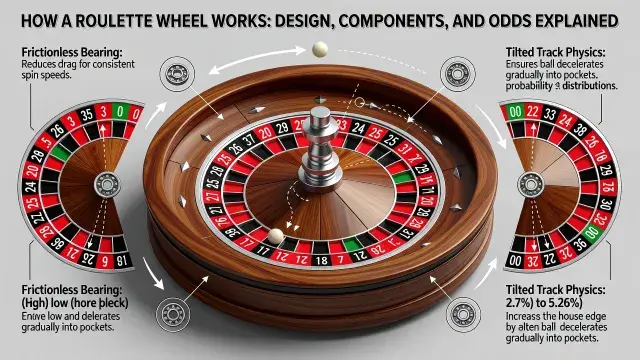
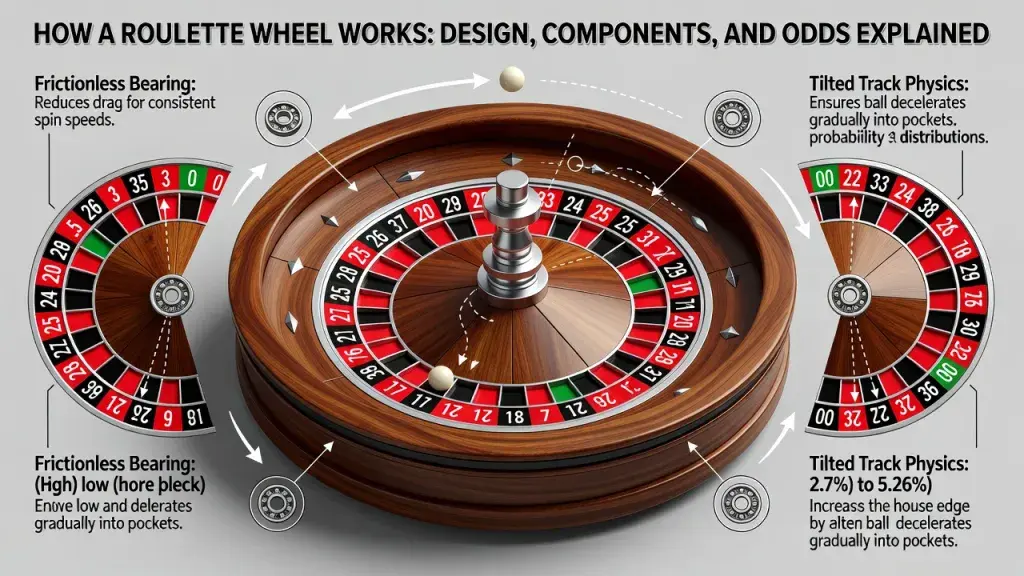
A regulation roulette wheel contains 37 or 38 pockets, spins on a nearly frictionless bearing, and can complete dozens of rotations before a ball finally settles - yet the entire outcome is decided by physics that has barely changed in two centuries. That combination of mechanical simplicity and mathematical precision is why the game has survived every fad in casino history. Most players sit at the table and watch the ball bounce without ever asking why the wheel is built the way it is.
The wheel itself is a study in deliberate asymmetry. Numbers aren't placed in sequence; they're arranged according to a specific pattern designed to balance red against black and odd against even across the wheel's circumference. Before exploring that pattern, it helps to understand the broader context of the game - for readers unfamiliar with the basics, the page on what is roulette wheel offers a useful primer on the game's origins and core mechanics. Once that foundation is clear, the finer details of pocket layout, ball behavior, and payout structure make far more sense.
This piece breaks down the wheel's construction piece by piece, explains how the physical components interact during a spin, and walks through the odds tied to every type of bet. By the end, you'll understand not just how to play roulette, but why the wheel produces the results it does.
What Is a Roulette Wheel and Why Its Design Matters
A roulette wheel is a precision-engineered device consisting of a stationary bowl and a rotating disc, numbered pockets, and a ball track, all built to produce a result that no player, dealer, or casino can predict or control. Its design matters because even microscopic irregularities - a slightly worn bearing, an uneven pocket, a loose frets - can introduce bias into what's supposed to be a purely random event. Casinos invest heavily in wheel maintenance for exactly this reason.
The Purpose of a Balanced Wheel
Balance is the entire point of roulette wheel design. If certain numbers hit more often than statistical probability allows, the house edge shifts unpredictably, and so does player trust. Manufacturers calibrate wheels to extremely tight tolerances so that no pocket has a physical advantage over another.
European vs. American Roulette Wheel Layouts
The two dominant formats differ in one critical way: the American wheel adds a double-zero pocket, bringing the total to 38 numbers, while the European wheel has only a single zero for 37. This single difference changes the house edge substantially and is the first thing an informed player should check before sitting down at a table.
Why Wheel Design Affects Player Trust
Transparency in construction - visible bearings, clear pocket separators, regulated manufacturing standards - reassures players that outcomes aren't manipulated. Regulatory bodies in licensed jurisdictions require regular testing of wheel balance and randomness, which is part of why physical roulette remains one of the most trusted casino games.
Roulette Wheel Components Explained
Understanding roulette wheel components clarifies why the game behaves the way it does. Each part serves a specific mechanical function, and together they create the randomness the game depends on.
The Wheelhead and Bowl
The wheelhead is the rotating disc containing the numbered pockets; the bowl is the stationary outer structure that houses it. The wheelhead spins independently on a spindle, supported by a precision bearing that allows it to rotate smoothly for an extended period with minimal friction loss.
Pockets, Frets, and Numbering
Pockets are the individual compartments where the ball comes to rest, separated by metal or synthetic dividers called frets. Frets vary in height and shape between manufacturers - lower frets tend to produce more "bouncy" outcomes, while higher frets create sharper, more decisive drops.
The Ball Track and Deflectors
The ball track is the tilted outer rim where the dealer spins the ball; deflectors are small obstacles placed around the track designed to disrupt the ball's path and add unpredictability as it loses momentum. Without deflectors, a skilled dealer could potentially predict landing zones with more consistency than casinos would like.
Spindle and Bearing System
The spindle holds the wheelhead in place, while the bearing system underneath allows it to rotate freely. A well-maintained bearing produces long, even spins; a degraded one causes wobble, which can subtly bias results toward certain sections of the wheel.
- Wheelhead - the rotating numbered disc
- Bowl - the stationary housing structure
- Pockets and frets - where the ball lands and settles
- Ball track - the rim where the ball spins before descending
- Deflectors - obstacles that randomize the ball's final path
- Spindle and bearing - the mechanical core enabling rotation
How Roulette Wheel Works: The Physics Behind Every Spin
How a roulette wheel works comes down to a controlled collision between two independent forces: the spinning wheelhead and the ball moving in the opposite direction along the tilted track. As the ball loses velocity, gravity pulls it down the slope of the bowl, where it strikes the deflectors and pocket frets before settling.
The Spin-and-Ball Sequence
The dealer spins the wheelhead in one direction and releases the ball in the opposite direction along the upper track. This opposing motion is intentional - it maximizes the unpredictability of where the ball will eventually cross paths with the slowing wheelhead.
Momentum, Friction, and Deceleration
Friction between the ball and track, combined with air resistance, gradually reduces the ball's speed. Once it can no longer maintain its orbit against gravity, it drops toward the wheelhead - the exact moment and location of this drop are what generate the game's randomness.
Why the Outcome Is Nearly Impossible to Predict
Even with identical starting speed and force, tiny variances in air currents, surface texture, and ball rotation make outcomes practically impossible to forecast with the naked eye. This is precisely why physical roulette remains resistant to advantage play in a way that many other casino games are not.
Roulette Wheel Odds Explained
Roulette wheel odds are determined entirely by the number of pockets and the specific bet placed - no skill or strategy changes the underlying probability of any individual spin.
Single-Number Bets and Their True Probability
On a European wheel, a straight bet on one number carries a probability of 1 in 37; on an American wheel, it's 1 in 38. That extra pocket might look negligible, but it meaningfully increases the house edge over the long run.
Even-Money Bets: Red/Black, Odd/Even, High/Low
These bets pay 1:1 and come closest to a coin-flip probability, but the presence of zero (or double zero) skews the true odds slightly in the house's favor. Players often gravitate toward these bets because the frequency of wins feels more consistent, even though the mathematical edge remains unchanged.
Column and Dozen Bets Compared
Column and dozen bets both cover 12 numbers and pay 2:1, offering a middle ground between the volatility of single-number bets and the steadiness of even-money wagers. Choosing between them is purely a matter of preference, since their odds are mathematically identical.
How Zero and Double Zero Affect the House Edge
The single zero on a European wheel gives the house an edge of roughly 2.7%, while the added double zero on an American wheel pushes that edge closer to 5.26%. This is arguably the single most important number a player should understand before choosing which wheel format to play.
Roulette Wheel Design Variations Around the World
Not every roulette wheel follows the same blueprint. Regional preferences, regulatory requirements, and manufacturing traditions have produced several distinct variants over time.
French Roulette Wheel Features
French wheels typically use the same single-zero layout as European wheels but introduce rules like "La Partage," which returns half of even-money bets to players if the ball lands on zero. This rule effectively lowers the house edge on those specific bets to roughly half of the standard European figure.
American Double-Zero Wheels
American wheels arrange numbers differently from their European counterparts, and the addition of the double zero changes both the numerical sequence and the statistical balance of the wheel. This layout is standard across most casinos in the United States.
Modern Electronic and Hybrid Wheels
Some venues now use electronic sensors embedded in the wheel to track results automatically, feeding data into digital displays without altering the physical mechanics of the spin. These hybrid systems preserve the tactile experience of a real wheel while adding speed and transparency to result tracking.
Reading and Interpreting a Roulette Wheel Layout
Learning to read the wheel layout - as opposed to the betting table - gives players insight into how numbers are physically distributed, which matters for strategies like sector betting.
Number Sequence Logic
Numbers on a roulette wheel are arranged in a specific non-sequential order designed to alternate colors and balance high and low values around the circumference. This layout differs entirely from the numerical order seen on the betting table.
Color Distribution Patterns
Red and black pockets alternate as much as the number sequence allows, though the presence of green zero pockets breaks perfect symmetry. Understanding this pattern helps explain why certain number groupings feel intuitive to experienced players.
Why Wheel Order Differs From Table Layout
The betting table lists numbers in straightforward ascending order for ease of placing chips, but the wheel itself uses a scrambled sequence to prevent any predictable relationship between adjacent numbers and adjacent bets. This separation is deliberate and reinforces the game's unpredictability.
Frequently Asked Questions
Why does the American wheel have worse odds than the European wheel?
The American wheel includes an extra pocket - the double zero - which increases the total number of possible outcomes without increasing payouts. This raises the house edge from about 2.7% to roughly 5.26%, making the European wheel mathematically more favorable for players.
Can a roulette wheel be biased toward certain numbers?
Yes, mechanical wear, warping, or an unlevel installation can cause a wheel to favor specific pockets over time. Casinos routinely test and recalibrate wheels to prevent this, since a biased wheel can be exploited by attentive players tracking results.
Does the speed of the spin affect the outcome?
Spin speed influences how long the ball stays in motion but doesn't change the underlying randomness of where it lands. Dealers vary their spin strength specifically to avoid falling into predictable rhythms that could be studied.
Why are the frets sometimes different heights on different wheels?
Fret height affects how much the ball bounces before settling into a pocket. Lower frets, often used on modern low-deflection wheels, create more erratic bouncing, while taller, older-style frets tend to produce quicker, more decisive landings.
Is it possible to predict where the ball will land using physics?
In controlled laboratory conditions with precise timing equipment, some researchers have demonstrated partial predictive success, but real-world casino conditions - variable spin speed, ball wear, and dealer variation - make this impractical in practice. Casinos also actively monitor for behavior suggestive of such tracking.
What's the difference between a dozen bet and a column bet in terms of odds?
Both bets cover exactly 12 numbers and pay 2:1, so their statistical odds are identical. The only real difference is which specific numbers are grouped together, which matters only if a player is targeting particular sections of the wheel.